Per vial, USD
| Fill weight | 100+ | 1,000+ | 2,500+ | Order |
|---|---|---|---|---|
| 10 mg | $8.78 | $7.37 | $7.20 | |
| 30 mg | $23.63 | $19.85 | $19.38 | |
| 60 mg | $56.25 | $47.25 | $46.13 |
Ordering at volume
Tirzepatide is stocked at three fill weights spanning a sixfold range, the widest spread of any incretin line here, and choosing between them is the main decision on a purchase order. A long lipidated peptide is priced mostly on the material inside the vial, so the per-vial rate climbs steeply from 10 mg to 30 mg to 60 mg and the saving per milligram at the top fill is real but modest. Fewer vials to store argues for 60 mg; the lowest per-vial figure argues for 10 mg.
Every fill is its own quoted line, and only its own quantity carries it up the tier ladder, so an order split evenly across the three fills sits at the entry tier three times over while the same vials on one fill may clear a break outright. When a line lands just short of a break, ask for the quote at the break quantity: the extra vials frequently cost less than the difference in rate. Above 10,000 vials on one line the order moves to contract terms.
As a high-volume staple the material is held deep in California and a confirmed order normally leaves within days, Monday to Friday. Expect one lot per fill weight on a mixed order, each lot number on carton and vial label, and a certificate of analysis for that lot on request. On a first order confirm that carton, label and certificate agree, and count kits before breaking any seal.
Specification
- Compound
- Tirzepatide
- CAS number
- 2023788-19-2
- Formula
- C₂₂₅H₃₆₀N₆₂O₈₅
- Molecular weight
- 4,813.5 g/mol
- PubChem CID
- 137346133
- Form
- Lyophilized powder, sealed vial
- Fill weights
- 10 mg · 30 mg · 60 mg
- Stock depth
- High-volume staples — Held deepest, quoted same day, shortest lead time.
- Intended use
- Laboratory research only. Not for human or veterinary use.
What the material is
Tirzepatide is a synthetic single-chain peptide of 39 residues in the incretin class. Two positions in the chain, 2 and 13, carry α-aminoisobutyric acid (Aib) in place of the amino acids of the natural sequence at those positions. Aib is not one of the twenty coded amino acids: it is a small achiral residue with two methyl groups on the α-carbon, and its presence at both positions distinguishes tirzepatide from a plain incretin sequence on a mass spectrum.
The lysine at position 20 is the point of lipidation. It carries a C20 fatty diacid, eicosanedioic acid, joined to the side-chain amine through a γ-glutamate residue and two OEG units (2-[2-(2-aminoethoxy)ethoxy]acetic acid). The complete molecule, linker and diacid included, has a molecular weight of 4,813.5 g/mol, one of the heaviest single-chain peptides here.
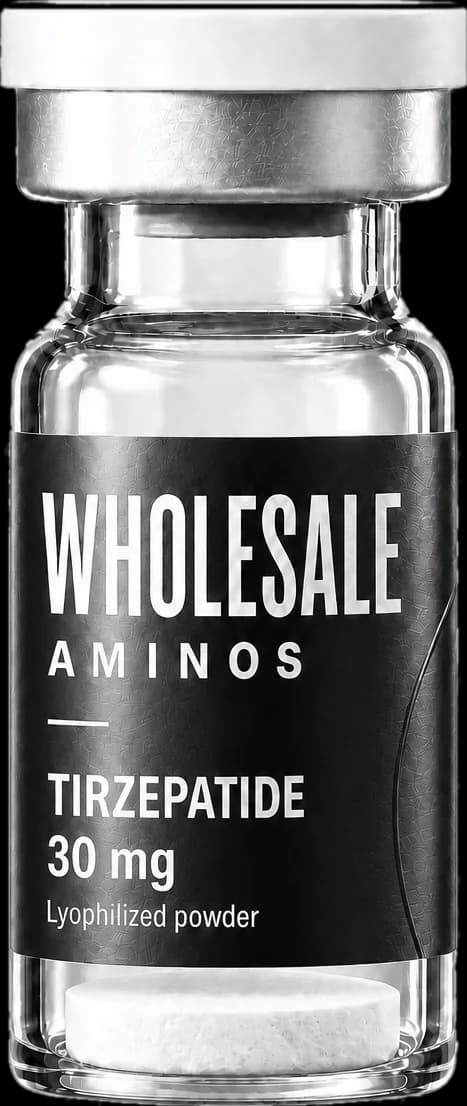
Supplied form is a compact off-white cake in a glass vial under a rubber stopper and an aluminium crimp, with no diluent. A sound cake sits as one piece with a flat or slightly domed top; shrinkage, a cake that has slid down the glass, or a glassy film on the base are the signs to look for on receipt. Fill weights stocked are 10, 30 and 60 mg per vial.
Storage and reconstitution
Keep sealed vials frozen at −20 °C, dry and out of light, for long-term holding; a refrigerator at 2–8 °C is adequate for a few weeks between receipt and use. The lyophilized solid is far more tolerant of temperature than the dissolved peptide, and a brief ambient excursion in transit does not compromise a vial still under seal. Let a cold carton warm before vials are handled, so condensation does not form.
The powder wets slowly, as a lipidated molecule of this size does. Sterile water or a mildly buffered aqueous solvent takes it into solution at room temperature if the vial stands for a minute and is then rolled gently; agitation raises foam, and foam is where aggregates form. The result should be clear and colourless. Cloudiness that does not clear on standing points to aggregation or to a solvent whose pH is too low for an acylated peptide.
Dissolved tirzepatide has a short working life: keep it at 2–8 °C in the dark and use it promptly. If it must be frozen, divide it into single-use portions first, since a solution thawed and refrozen more than once degrades.
Buying questions
Why does the 60 mg tirzepatide vial cost so much more than the 10 mg vial?
Because the price of a long lipidated peptide is set by the material in the vial rather than by the vial itself. Six times the peptide does not cost six times as much, but it costs far more than the same step on a small unmodified peptide would. The order list shows each fill once the sheet is confirmed.
Does an order of 10, 30 and 60 mg tirzepatide reach one tier or three?
Three. Every fill weight is its own line with its own count toward the breaks, so 400 vials at each fill is three entry-tier lines rather than one Tier 2 order. Concentrating the order on a single fill gets to a break with fewer vials.
What does a tirzepatide cake look like when it has been damaged in transit?
One that has come away from the glass, shrunk to a fraction of the vial base, or collapsed into a glassy layer. An intact cake stays as one piece and does not move when the vial is tilted. Photograph anything that looks wrong before opening more of the shipment and raise it through the contact page.
How quickly does wholesale tirzepatide ship after a quote is accepted?
It is one of the lines held deepest, so a confirmed order at any tier normally leaves California within days, on a weekday. The ship date on the written quote is the one to plan around; above 10,000 vials on this line the order moves to contract terms and is scheduled individually.
