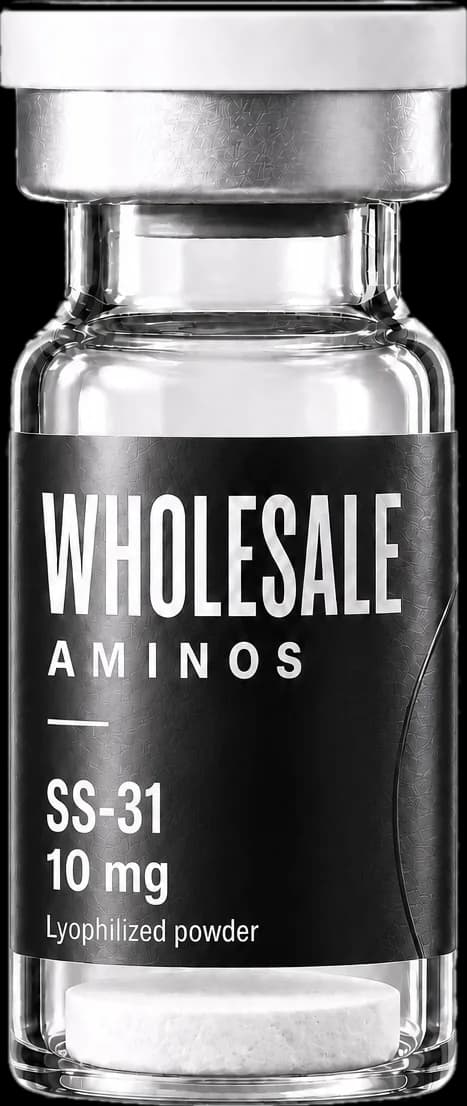
Per vial, USD
| Fill weight | 100+ | 1,000+ | 2,500+ | Order |
|---|---|---|---|---|
| 10 mg | $16.25 | $13.65 | $13.33 |
Ordering at volume
SS-31 is a standard-catalog line held in California at a single fill of 10 mg, so there is no fill weight to choose and the whole order quantity of the compound counts toward one ladder. Its tier is set by the SS-31 count alone, whatever else is on the order.
The purchasing detail that matters is the basis of the fill. A 10 mg vial can be filled to 10 mg of solid or to 10 mg of peptide corrected for salt and water content, and the two are not the same quantity of peptide. Ask which basis the label uses and have the answer recorded on the quote. A non-standard residue also makes the identity test more important than for a plain peptide, so a first order should come with the certificate in hand.
Lead time from standard stock is a few working days for quantities the shelf covers; orders that outrun the stocked quantity wait for the next lot and are quoted with a date. An order at the upper break may be assembled from two lots, each with its own certificate.
Specification
- Compound
- SS-31
- CAS number
- 736992-21-5
- Formula
- C₃₂H₄₉N₉O₆ · 4HCl
- Molecular weight
- 640.80 g/mol (free base)
- Form
- Lyophilized powder, sealed vial
- Fill weights
- 10 mg
- Stock depth
- Standard catalog — Stocked in California. Each compound gets its price break on its own count.
- Intended use
- Laboratory research only. Not for human or veterinary use.
What the material is
SS-31, listed on the page under its alias elamipretide, is a synthetic peptide of four residues. One of those residues is 2',6'-dimethyltyrosine, a non-proteinogenic amino acid, which is why the compound cannot be described purely in terms of the twenty standard building blocks and why its identity is normally confirmed by mass rather than by amino acid analysis alone. The molecular weight is not restated here; the certificate for a given lot reports the observed mass for the form supplied.
Whether a lot is supplied as the free peptide or as a salt, and which salt, is stated on the certificate rather than assumed, because the salt form changes the mass of solid that corresponds to a given mass of peptide. The solid as supplied is white to off-white and lyophilized, in a sealed glass vial; a salt of a short peptide may present as a powder rather than a coherent cake, and that is not a fault.
Storage and reconstitution
Keep the sealed vial at −20 °C, dry and in the dark. If the lot is a salt form, regard it as more hygroscopic than a free peptide and let the vial reach room temperature before opening it, so no condensation forms on the solid.
It dissolves readily in water. The dimethylated tyrosine does not hinder solubility, and a short peptide of this kind gives a clear solution within a minute of gentle mixing. Salt forms produce a mildly acidic solution in unbuffered water, which is worth knowing if the solution is going into a pH-sensitive assay.
Once in solution, refrigerate and keep dark. Aliquot before freezing; a working stock that is frozen and thawed repeatedly loses integrity, and a peptide carrying a phenolic side chain is also better kept away from prolonged light.
Buying questions
Is SS-31 the same material as elamipretide?
Yes; elamipretide is the non-proprietary name and SS-31 the research code for the same tetrapeptide, and the page lists both. Order under either name and the quote will carry both.
Does the 10 mg SS-31 fill refer to peptide or to total solid?
The basis is stated on the quote and the certificate. A salt form contains counter-ion and water in addition to peptide, so a fill stated as total solid holds less peptide than a fill stated as net peptide; ask for the basis in writing before comparing quotes from two suppliers.
Why is only one fill weight of SS-31 stocked?
Because one fill covers what this line is asked for. A different fill is not a stock item; note the fill you need on the order request and the desk will reply in writing.
How is the identity of a lot with a non-standard residue confirmed?
By mass. The certificate reports the observed molecular mass against the expected value for the form supplied, which is the direct check for a peptide containing a residue that ordinary amino acid analysis does not resolve. Purity by chromatography is reported alongside it; see the quality page.
