Per vial, USD
| Fill weight | 100+ | 1,000+ | 2,500+ | Order |
|---|---|---|---|---|
| 10 mg | $15.75 | $13.23 | $12.92 | |
| 50 mg | $40.50 | $34.02 | $33.21 |
Ordering at volume
Epithalon is a standard-catalog line stocked in California at two fill weights, 10 mg and 50 mg, and the choice between them is the main purchasing decision. The peptide itself is inexpensive to make, so a vial's cost is mostly its vialing and freeze-drying; the 50 mg fill carries five times the material for a price step well short of that. Labs that draw large amounts per vial buy the 50 mg fill, while those that want many small vials buy the 10 mg fill and accept a higher cost per milligram in exchange for fewer opened vials.
The two fills are separate lines. Each fill weight hits the volume and bulk breaks by itself, and there is no advantage in mixing fills to reach a break. A first order at either break often ships from one lot, and the lot number on the label matches the certificate supplied for it.
Lead time from stock is short; orders beyond the stocked quantity are given a date on the written quote. A written quote comes back the same business day in most cases and restates the fill weights, counts and the tier reached on each line.
Specification
- Compound
- Epithalon
- CAS number
- 307297-39-8
- Formula
- C₁₄H₂₂N₄O₉
- Molecular weight
- 390.34 g/mol
- Form
- Lyophilized powder, sealed vial
- Fill weights
- 10 mg · 50 mg
- Stock depth
- Standard catalog — Stocked in California. Each compound gets its price break on its own count.
- Intended use
- Laboratory research only. Not for human or veterinary use.
What the material is
Epithalon, also spelled Epitalon, is a synthetic linear tetrapeptide: alanine, glutamic acid, aspartic acid and glycine, in that order, with a molecular weight of 390.34 g/mol. Two of its four residues carry acidic side chains, so the free peptide is acidic and its solutions in plain water run below neutral pH. It is one of the smallest peptides in the catalog and among the simplest to synthesize and to verify.
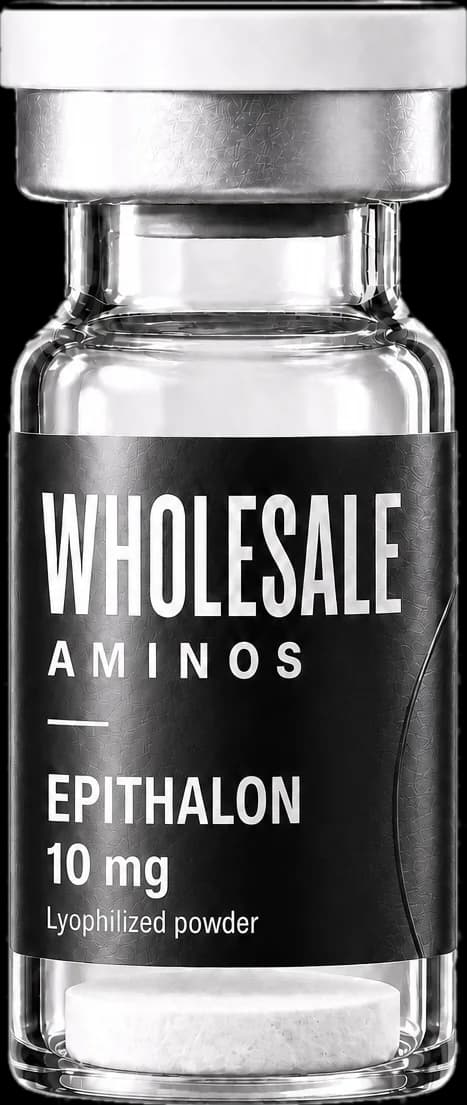
It is supplied as a white lyophilized solid in a crimp-sealed glass vial. At the 10 mg fill the solid is a thin cake or a light dusting across the base of the vial; at 50 mg it is a substantial cake. Small acidic peptides can pick up moisture once the seal is broken, so an unopened vial that looks damp or glassy rather than dry and matte should be set aside and reported.
Storage and reconstitution
The sealed vial should be frozen at −20 °C and kept dry and dark. The peptide is robust under seal; refrigerated storage is fine for shorter periods, and the short excursions of shipping do not matter.
Solubility in water is high and the solid disappears almost on contact with the solvent. Since the free peptide is acidic, an unbuffered solution will be mildly acidic; use a buffer if the downstream assay requires neutral pH. The solution should be water-clear.
Keep solutions cold and dark and use them promptly. Short peptides are generally more tolerant of freezing than long ones, but the rule of dividing a solution into single-use portions before freezing still applies, and a solution that has gone through many freeze-thaw cycles should be discarded rather than assayed.
Buying questions
When does the 50 mg Epithalon fill make more sense than the 10 mg fill?
When the receiving lab draws a lot of material from each vial. The 50 mg fill costs far less per milligram because vialing and freeze-drying, not peptide, set the price of a small tetrapeptide. The 10 mg fill suits labs that would rather open a fresh small vial each time.
Is Epithalon hygroscopic?
Moderately, once the seal is broken. A small acidic peptide will pick up water from the air, so opened vials should be used rather than resealed and stored, and unopened vials should reach room temperature before opening to avoid condensation.
Is Epitalon a different product from Epithalon?
No, they are two spellings of one tetrapeptide; both appear on the page, and orders written either way are filled from the same stock.
