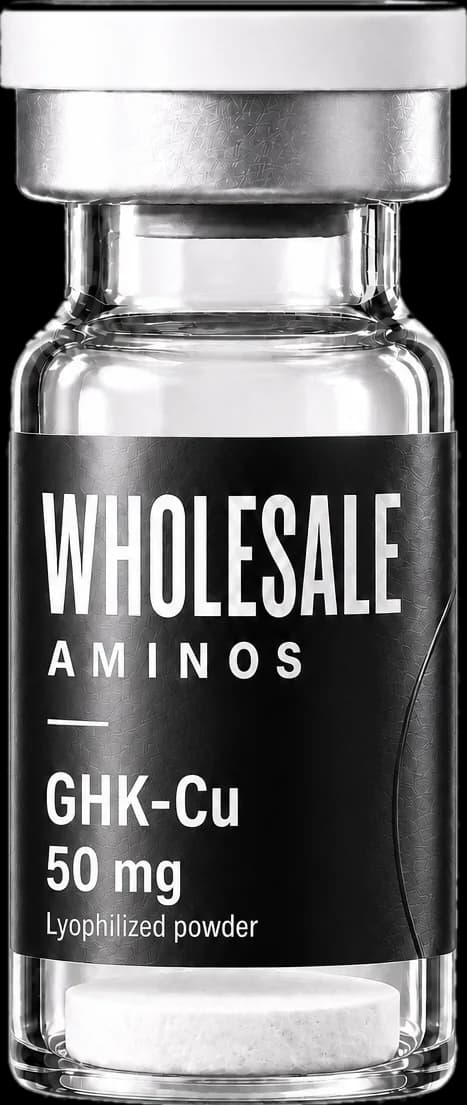
Per vial, USD
| Fill weight | 100+ | 1,000+ | 2,500+ | Order |
|---|---|---|---|---|
| 50 mg | $7.42 | $6.24 | $6.09 | |
| 100 mg | $9.68 | $8.13 | $7.94 |
Ordering at volume
GHK-Cu is a high-volume line, held deep and shipped in days. The two fills, 50 mg and 100 mg, are large by peptide standards because the material is cheap per milligram and buyers draw on it heavily; the 100 mg fill is the usual wholesale choice, and the per-vial figures for both are being confirmed against the current sheet. Each fill is quoted separately and climbs toward the breaks on its own vials.
The colour is a useful check. Vials from one lot should look the same shade, so a mixed-shade kit is worth querying as a possible mixed lot or a vial that has taken on moisture, and it costs nothing to look on receipt. Because the material is a metal complex rather than a plain peptide, ask that the certificate report the copper content alongside the peptide assay if your specification needs both; the routine certificate reports identity and purity of the complex.
The blend lines that contain GHK-Cu, such as the Glow blend, are separate products with their own quantities and do not count toward the GHK-Cu ladder. The quote identifies which lot an order draws on, and it normally comes back the same business day.
Specification
- Compound
- GHK-Cu
- CAS number
- 89030-95-5
- Formula
- C₁₄H₂₄CuN₆O₄
- Molecular weight
- 340.9 g/mol
- PubChem CID
- 5311476
- Form
- Lyophilized powder, sealed vial
- Fill weights
- 50 mg · 100 mg
- Stock depth
- High-volume staples — Held deepest, quoted same day, shortest lead time.
- Intended use
- Laboratory research only. Not for human or veterinary use.
What the material is
GHK-Cu is the tripeptide glycine-histidine-lysine complexed with a copper(II) ion; the peptide and the metal are supplied together as one material and the catalog line refers to the complex, not to the metal-free peptide. The molecular weight is not restated here because the figure depends on which species is counted, and the certificate for a lot reports the mass observed for the form supplied together with its copper content where that has been requested.
The copper is what gives the compound its colour. Unlike nearly everything else in the catalog, the lyophilized solid is blue to blue-violet rather than white. It is supplied in a sealed glass vial at 50 mg and 100 mg, the larger fills reflecting that this is a compact, inexpensive tripeptide that is normally bought in quantity.
Storage and reconstitution
Keep the sealed vial frozen or refrigerated, dry, and out of direct light; the complex is more forgiving of temperature than most peptides, but it is hygroscopic and a damp vial loses its powdery texture and darkens. Allow it to warm to room temperature before the seal comes off.
It goes into water readily and the solution is a clear blue. Buffers that contain EDTA or other strong metal chelators are unsuitable, since they strip the copper from the peptide and change what is in the tube; phosphate and similar buffers near neutral pH are suitable. A solution that is not blue, or that has thrown a precipitate, is not what was supplied.
Solutions are reasonably stable refrigerated and shielded from light. As with any peptide solution, portion before freezing and avoid repeated freeze-thaw cycles; a change in the colour of a stored solution is the sign to discard it.
Buying questions
Why is GHK-Cu blue, and what should a vial look like?
The blue to violet colour comes from the copper(II) ion complexed by the tripeptide, and it is the expected appearance of the lyophilized solid. A uniform blue cake or powder is correct; a whitish, mottled or darkened vial is worth photographing and reporting.
Does the GHK-Cu certificate report copper content?
The routine certificate reports identity and purity of the complex; a copper assay is added on request. State the requirement on the purchase order so the lot is tested before release, and collect the document through COA requests.
Which GHK-Cu fill weight is stocked deeper, 50 mg or 100 mg?
Both are held deep, since this is a high-volume line, and either ships in days. The 100 mg fill is the more common wholesale choice because the material is inexpensive per milligram and the larger vial halves the vial count for the same mass.
