Per vial, USD
| Fill weight | 100+ | 1,000+ | 2,500+ | Order |
|---|---|---|---|---|
| 10 mg | $11.47 | $9.64 | $9.41 | |
| 20 mg | $20.00 | $16.80 | $16.40 | |
| 40 mg | $40.50 | $34.02 | $33.21 |
Ordering at volume
MOTS-c is a standard line stocked in California, and it is held at three fill weights: 10 mg, 20 mg and 40 mg. A mid-length peptide of sixteen residues sits between the two cost regimes, with synthesis and vialing each a real share of the vial price, so the ladder climbs steadily from 10 mg to 40 mg rather than flattening the way it does for a tripeptide or tracking mass the way it does for a long peptide.
The three fills are three lines. Quantity on one fill does not help another reach a break, so a buyer who wants the volume tier should concentrate the order on one fill rather than spreading it; the fill weight should be settled before the quote is requested, since the quote is written line by line. The contract-pricing threshold of 10,000 vials is counted on one fill, not on the three combined.
An order at the 2,500 vial break may draw on two lots, and the quote will say so; the certificate for each lot is available on request. Orders beyond stock are given a date at quote.
Specification
- Compound
- MOTS-c
- CAS number
- 1627580-64-6
- Formula
- C₁₄₉H₂₆₀N₄₆O₄₆S₂
- Molecular weight
- 2,171.5 g/mol
- PubChem CID
- 91808068
- Form
- Lyophilized powder, sealed vial
- Fill weights
- 10 mg · 20 mg · 40 mg
- Stock depth
- Standard catalog — Stocked in California. Each compound gets its price break on its own count.
- Intended use
- Laboratory research only. Not for human or veterinary use.
What the material is
MOTS-c is a synthetic peptide of sixteen amino acid residues. Its full name on the page, mitochondrial open reading frame of the 12S rRNA-c, records where the sequence was first described and is not a description of the material in the vial, which is a chemically synthesized linear peptide like the others in this section. No molecular weight is restated for this line; each lot's certificate reports the observed mass.
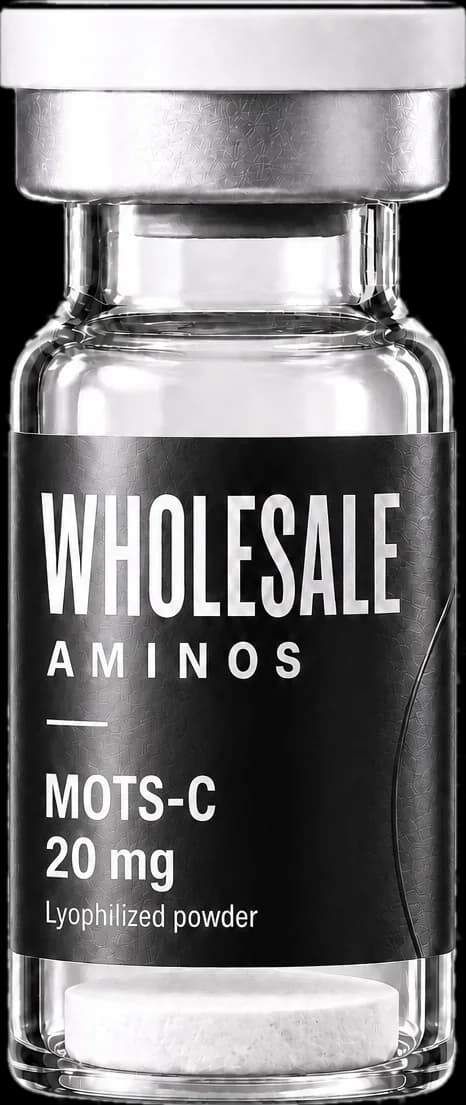
Three fills are stocked, each a white to off-white freeze-dried cake in a crimp-sealed vial. The 40 mg fill is a visibly larger cake and the 10 mg fill is a thin disc, and all three should look dry, matte and intact. A cake that has slumped or a glassy film at the base of the vial should be reported before the shipment is unpacked further.
Storage and reconstitution
The sealed vial belongs in a freezer at −20 °C, kept dry and shaded. Refrigeration is acceptable for shorter periods. Do not open a cold vial; let it come to room temperature first.
Sterile water or a neutral buffer, added gently to the inside wall of the vial, takes it up. A sixteen-residue peptide dissolves without heating but may take a minute or two longer than a tripeptide, so allow it to stand and swirl rather than shake. The finished solution should be clear and without particles.
Keep solutions refrigerated and dark and use them within a short working period. Divide any solution destined for the freezer into portions first; a portion thawed once and used is fine, while a stock thawed repeatedly is where degradation shows up.
Buying questions
Which of the three MOTS-c fill weights should a wholesale order concentrate on?
The one the receiving lab will actually draw from, and then all of it on that fill, because tiers are reached per fill weight. Splitting 1,000 vials across 10 mg, 20 mg and 40 mg gives three opening-tier lines; putting them on one fill gives a volume-tier line.
Does the MOTS-c name mean the material is extracted rather than synthesized?
No. The name records where the sequence was first described; the material in the vial is a chemically synthesized sixteen-residue peptide, and its identity is confirmed by mass on the lot certificate.
Will a large MOTS-c order come from one lot?
Not always. An order at the 2,500 vial break may be assembled from two lots, in which case the quote says so in advance and each lot ships with its own certificate on request through COA requests.
